Physical Address
304 North Cardinal St.
Dorchester Center, MA 02124
Physical Address
304 North Cardinal St.
Dorchester Center, MA 02124

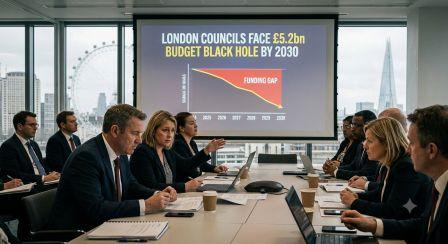
London, 22 September 2026 — London’s town halls are bracing for a combined budget shortfall of £5.2 billion over the next four years, according to fresh analysis from London Councils, the body representing the capital’s 33 local authorities. The figure marks a sharp deterioration from the £4.7 billion gap the organisation forecast just eleven months ago — and more than double the £2.2 billion shortfall it was predicting the year before that.
The scale of the crunch means boroughs are already grappling with an almost £1.2 billion gap in the current financial year alone, driven largely by soaring demand for adult social care, homelessness support and services for children with special educational needs — all of which councils are legally obliged to provide, regardless of what they can afford.
Nine boroughs now on emergency support
Perhaps the starkest sign of the strain is the growing number of authorities relying on the government’s Exceptional Financial Support (EFS) scheme, which allows struggling councils to take out emergency loans simply to balance their books. Nine London boroughs are now enrolled in the scheme, up from seven as recently as last October — a jump that local government figures say reflects just how quickly the picture is worsening across the capital.
Cllr Stephen Cowan, chair of London Councils, put the blame squarely on a funding system that hasn’t kept up with reality. He said funding had “failed to keep pace with skyrocketing costs and demand for services,” adding that the local government finance system was “broken.”
A widening gap, year after year
What makes this year’s warning particularly striking is the trajectory. London Councils’ rolling forecasts have moved from £2.2 billion, to £4.7 billion, to now £5.2 billion in the space of two annual updates — a trend borough leaders say shows the funding gap is not a one-off shock but a structural problem that’s accelerating.
Much of the pressure traces back to the government’s 2025 Fair Funding Review, which reshuffled how funding is distributed across England’s councils. While the review improved the position of some individual London boroughs, it also reduced the capital’s overall share of national local government funding — meaning that, once inflation is factored in, per-capita funding for London boroughs is set to fall even as costs for social care, temporary accommodation and SEND provision keep climbing.
What it means for residents
For ordinary Londoners, a funding gap of this size rarely stays confined to council spreadsheets. Previous rounds of budget pressure in the capital have translated into closed leisure centres, reduced bin collections, higher parking charges and cuts to non-statutory services such as libraries and youth clubs, as town halls protect legally mandated services at the expense of everything else.
London Councils says it hopes the coming government Budget will offer some relief, framing the moment as an opportunity to “help stabilise town hall finances” and give boroughs “more fiscal tools” to manage growing demand. But with the shortfall still projected to grow year-on-year through to 2030, most borough leaders are preparing for a tough settlement rather than a rescue package — and residents across the capital are likely to feel the effects of that squeeze long before any long-term fix arrives.
Sources